Savings Calculator
This savings calculator works backward from your goal: tell it the amount, the deadline, and an expected return, and it solves for the monthly contribution. To reach $50,000 in 10 years at 7%, you'd need to save about $288.88 per month.
Required Monthly Savings
To reach $50,000 in 10 years at 7%, save $288.88/month.
- Total monthly deposits over 10 years
- $34,665.60
- Covered by growth
- $15,334.40
Why plan savings backward from the goal?
Because "save what's left over" fails quietly, and a solved monthly number is a commitment you can automate. Working backward converts a someday-wish into a line item: the calculator inverts the compound-interest annuity formula (the same engine behind all compound growth) to find the exact deposit that lands on your target. Set up an automatic transfer for that amount and the goal stops depending on willpower. It also makes trade-offs visible before you commit — stretch the deadline a year, or nudge the goal down 10%, and watch the required monthly amount respond immediately.
What do common goals actually require?
Starting from zero, a $15,000 emergency fund in 3 years takes about $392.86 a month, a $60,000 house down payment in 8 years about $488.49, and a $120,000 college fund in 18 years about $278.60. Each target uses a rate assumption matched to how such money is typically held (shorter horizons belong in safer, lower-yield accounts):
| Goal | Amount | Timeline | Assumed return | Monthly savings |
|---|---|---|---|---|
| Emergency fund | $15,000 | 3 years | 4% | $392.86 |
| House down payment | $60,000 | 8 years | 6% | $488.49 |
| College fund | $120,000 | 18 years | 7% | $278.60 |
Does the rate assumption matter much?
Over short horizons, surprisingly little — so don't let uncertainty about returns stall the plan. For the three-year emergency fund above, assuming 2% instead of 6% changes the required contribution from $404.64 to $381.33 — a difference of about $23.31 a month. With so few compounding periods, your deposits do almost all the work and the growth assumption is a rounding error. The rate only becomes the main character on decade-plus goals like the college fund, where compounding has room to contribute meaningfully. That asymmetry has a happy practical consequence: for near goals, just start; for far goals, start now — the timeline is the assumption that matters most.
What if you fall behind?
Recalculate rather than abandon — the solver has no memory of the original plan. Enter today's balance as the starting balance, the same goal, and the time remaining, and it produces a fresh monthly number that accounts for everything you've already saved and every month of growth it will still earn. Falling behind by a few months typically moves the required contribution by a few percent, not the catastrophic amount guilt suggests. The reverse also works: after a windfall or a raise, rerun the numbers and either finish sooner or lower the monthly pressure.
Which account should the savings live in?
Match the account to the deadline, not to the highest advertised number. Money needed within a few years generally belongs where the balance can't drop when you need it — high-yield savings or CDs — which is why the emergency-fund row assumes a modest 4%. Longer goals can justify market exposure and its historically higher (but bumpier) returns. That choice is yours to make, ideally with a professional for large sums; what this calculator contributes is the honest monthly price tag for whichever assumption you pick.
Solve for any variable with Goal Mode
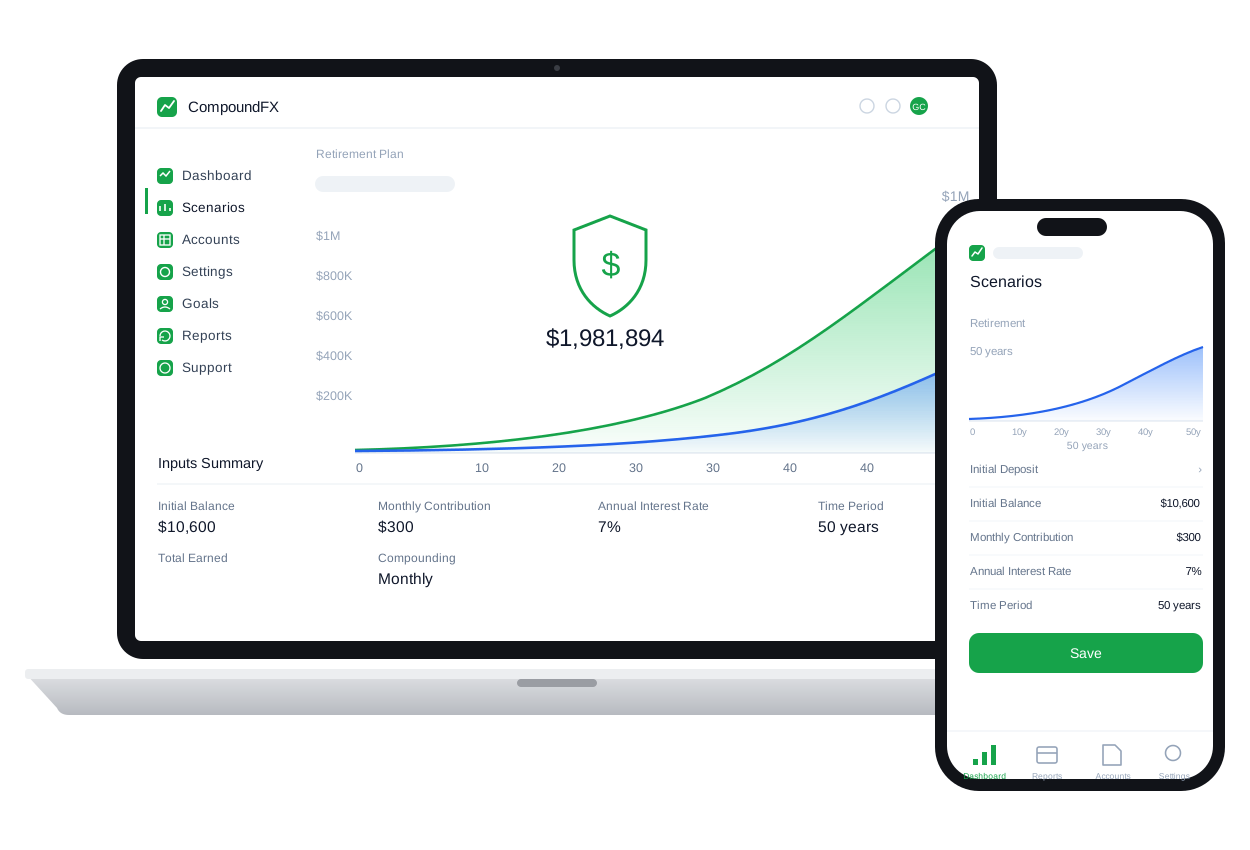
Solving for the monthly amount is one corner of the problem. CompoundFX's Goal Mode solves for any variable you're missing — required return, time to goal, starting principal, or the contribution — and saves each plan as a scenario.

Free to download. Optional one-time Pro upgrade. No subscription.