Frequently Asked Questions
Answers to the most common questions about compound interest, calculations, and how to get the most out of compounding.
What is compound interest?
Compound interest is interest calculated on your initial deposit plus all previously earned interest. Because each period's interest is added to the balance before the next calculation, your money grows exponentially rather than linearly. It's often described as "interest on interest," and it's the reason long time horizons matter more than large deposits.
How is compound interest calculated?
Compound interest is calculated by applying the periodic rate (the annual rate divided by the number of compounding periods) to your current balance, then adding that interest to the balance before the next period. Repeating this for every period produces the formula A = P(1 + r/n)nt. See the formula page for a step-by-step worked example.
What is the compound interest formula?
The compound interest formula is A = P(1 + r/n)nt, where P is the principal, r the annual rate as a decimal, n the number of compounding periods per year, and t the time in years. Every variable is explained with examples on the formula page.
How often should interest compound?
More frequent compounding always earns more, but the gains shrink rapidly beyond monthly. For $10,000 at 7% over 30 years, annual compounding gives $76,122.55, monthly gives $81,164.97, and daily gives only $480.28 more than monthly. Focus on the rate and time horizon; compounding frequency is a second-order effect.
What's the difference between APR and APY?
APR is the stated annual rate without compounding, while APY is the rate you actually earn once compounding within the year is included. A 7% APR compounded monthly works out to about 7.23% APY. When comparing savings accounts, compare APY to APY.
How can I increase the future value of my investment?
You can increase future value four ways: contribute more, earn a higher rate, compound more often, or — most powerfully — leave the money invested longer. Because growth is exponential in time, an extra decade typically beats a modestly higher rate or bigger deposit. The calculator lets you test each lever side by side.
What is the Rule of 72?
The Rule of 72 is a mental shortcut for doubling time: divide 72 by your annual return percentage to estimate the years needed to double your money. At 7% it estimates 10.3 years, while the exact logarithmic answer is 10.2 years — impressively close for mental math. Try the Rule of 72 calculator for a full comparison table.
Is compound interest better than simple interest?
Yes — for savers, compound interest always beats simple interest because you earn interest on past interest, not just on the principal. $10,000 at 7% for 30 years grows to $31,000.00 with simple interest but $76,122.55 with annual compounding. (When you're the borrower, compounding works against you the same way.)
Can I make additional contributions?
Yes — the calculator has a Monthly Contribution field, and contributions are added at the end of each month with monthly compounding. Regular contributions usually end up driving more of the final balance than the initial deposit does. Set it to 0 for a lump-sum-only projection.
Can I include inflation in my calculations?
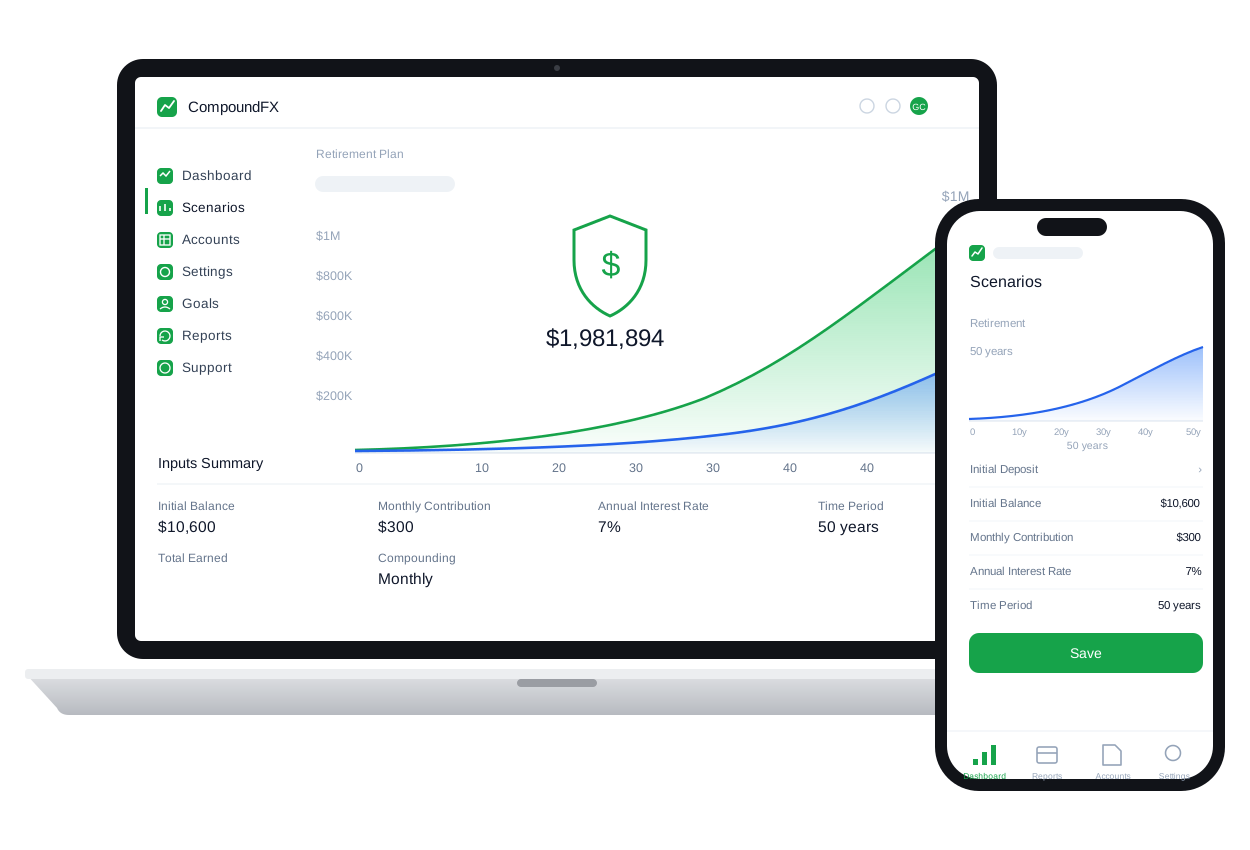
Not inside the main calculator — to keep projections easy to interpret, inflation is handled separately by the inflation calculator, which shows what a future amount is worth in today's dollars. If you want inflation adjustments built directly into your projections, the CompoundFX app includes them in its free tier.
Are the results adjusted for taxes?
No — this calculator deliberately keeps things simple and shows pre-tax growth, and your actual after-tax outcome depends on your account type and tax situation. If you want tax and expense-ratio adjustments in the projection itself, the CompoundFX app includes them in its free tier.
How accurate are the results from this calculator?
The math is exact for the inputs you provide, but the results are projections, not guarantees — real investments don't return a fixed rate every year. Market returns vary, and the calculator can't predict sequence-of-returns risk, fees, or taxes. Treat the output as a planning estimate for educational purposes, not financial advice.
How much does CompoundFX cost?
CompoundFX is free to download, and the full calculator — growth charts, year-by-year breakdowns, and inflation and tax adjustments — is included at no cost. An optional one-time Pro purchase of $4.99 unlocks Goal Mode, unlimited saved scenarios, side-by-side comparisons, and PDF reports, and it supports Family Sharing. There is no subscription.
Do you collect my data?
No accounts, no analytics, no data collection. Everything runs locally on your device. That applies to the CompoundFX app, and this website works the same way: the calculator runs entirely in your browser and your inputs are never sent to a server.
What's the best investment for compound growth?
Any investment that automatically reinvests its earnings compounds — common examples include savings accounts, CDs, and funds with dividend reinvestment enabled. Which is right for you depends on your goals, timeline, and risk tolerance, and that's a decision this site can't make for you: we provide educational projections, not investment advice.
How long does it take to double my money?
Divide 72 by your annual return to get a quick estimate: at 7% your money doubles in about 10.2 years (the Rule of 72 estimates 10.3). At 5% doubling takes 14.2 years, and at 10% just 7.3. The Rule of 72 page compares the estimate with the exact answer across rates.
Why do small, consistent contributions make such a big difference?
Because every contribution starts compounding the moment you make it, small regular deposits snowball into far more than their face value. Just $100 a month at 7% grows to $121,997.10 in 30 years — of which only $36,000 is money you put in; the remaining $85,997.10 is interest. Consistency matters more than size.
Does compound interest apply to debt too?
Yes — compound interest works exactly the same way on debt, which is why credit-card balances grow so quickly when you only make minimum payments. Card APRs often exceed 20%, compounding daily against you. Paying down high-interest debt is mathematically equivalent to earning that same rate, guaranteed.
No questions match your search.
Have a question we didn't answer?
We're always adding new content. Let us know what you'd like to see.