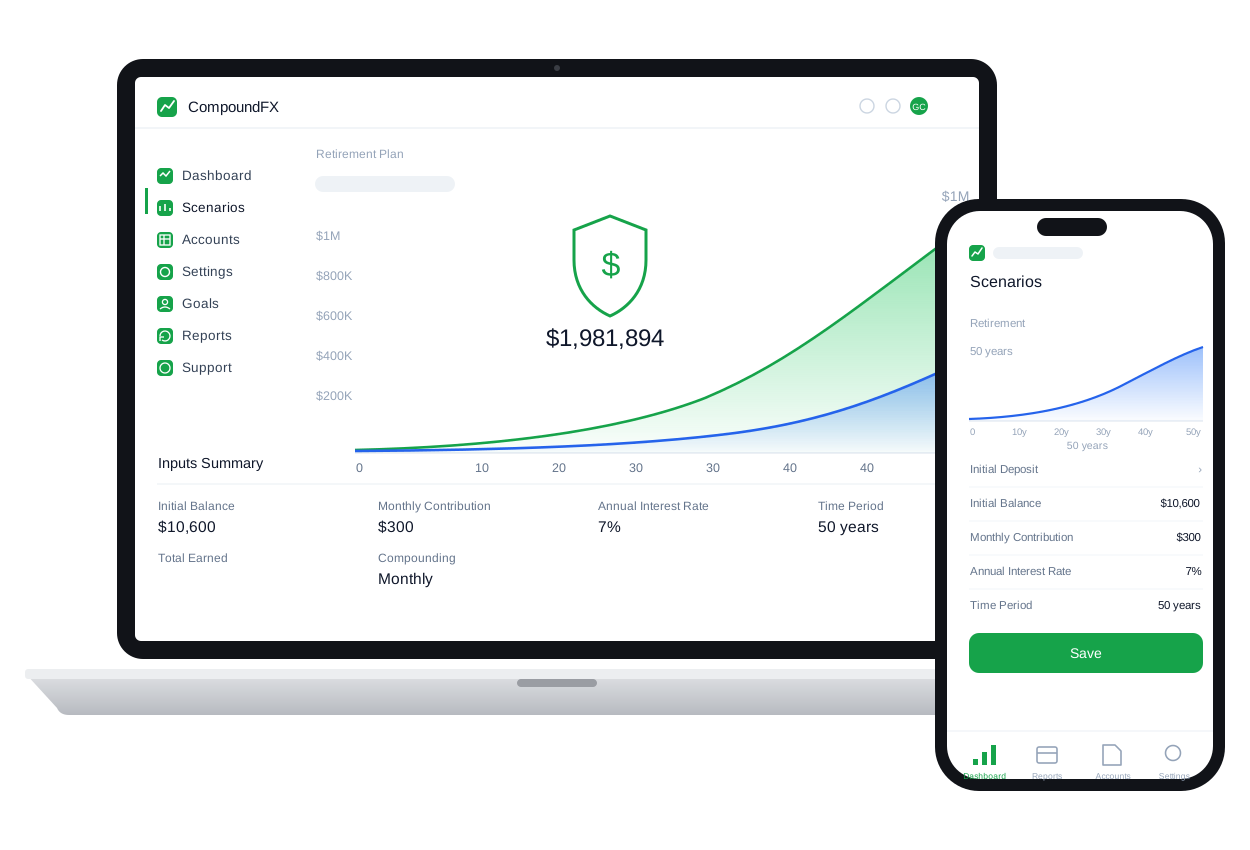
Compound interest is the money your money makes on the money it has already made — each round of interest joins your balance and starts earning interest of its own. That feedback loop is why a modest account left alone for decades can quietly outgrow a much larger one that started late, and why understanding it is the single most useful idea in personal finance.
How does compound interest work?
Compound interest works by adding each period’s interest to your balance so that the next period’s interest is calculated on a larger amount. Suppose you deposit $1,000 at 5% per year. After the first year you earn $50, so the second year’s 5% applies to $1,050.00 — not to your original $1,000. The interest itself starts earning interest, and the effect strengthens every year.
Contrast that with simple interest, where you’d earn the same $50 every year forever because interest is only ever calculated on the original deposit. In the first few years the difference feels trivial. Over decades, it’s enormous — we compare the two directly in Simple vs. Compound Interest.
A simple worked example
Here is $1,000 at 5%, compounded once per year:
| Year | Balance | Interest earned that year |
|---|---|---|
| 1 | $1,050.00 | $50.00 |
| 2 | $1,102.50 | $52.50 |
| 3 | $1,157.63 | $55.13 |
| 10 | $1,628.89 | — |
| 30 | $4,321.94 | — |
Notice two things. First, the interest earned each year keeps rising — $50.00, then $52.50, then $55.13 — even though you never deposit another cent. Second, the growth is back-loaded: it takes all ten early years to earn the first $629 of interest, but by year 30 the total interest is $3,321.94 — more than three times your original deposit, at a modest 5%.
That back-loading is the signature of exponential growth, and it has a practical moral: the most valuable years of compounding are the ones furthest in the future, which means the best time to start is now. We explore that idea properly in The Power of Starting Early.
What’s the formula?
The compound interest formula is , where is your starting amount, the annual rate as a decimal, how many times per year interest compounds, and the number of years. For the example above: , which gives $4,321.94.
You don’t need to compute this by hand — the calculator does it instantly, and the formula page walks through every variable with a step-by-step substitution if you want to understand the machinery.
Where you’ll meet compound interest in real life
Compound interest shows up on both sides of your balance sheet — it can work for you or against you.
- Savings accounts and CDs compound daily or monthly; the advertised APY already includes the compounding effect.
- Retirement and brokerage accounts compound through reinvested dividends and growth on growth. This is where long horizons do their most spectacular work.
- Credit cards and loans compound against you. A 24% card APR compounding daily grows a balance far faster than most investments grow savings, which is why carrying high-interest debt while investing rarely makes mathematical sense.
What should you remember?
Remember three things: compound growth is dramatically back-loaded, time matters more than the size of any deposit, and the same force works against you on high-interest debt. Because growth accelerates over the years, a small account with decades ahead of it beats a large one with only a few years. And since the force that builds wealth in a retirement account also builds debt on a credit card, the order of operations — pay down high-interest debt, then invest — usually takes care of itself.
If you’re new to all of this, the best next step is to play: open the calculator, enter a deposit and a timeline, and watch what happens when you change the years from 10 to 30.
Key terms at a glance
A handful of terms come up constantly in compound interest discussions, and knowing them makes everything else easier to read. (For questions rather than terms — APR vs. APY, how long doubling takes, whether frequency matters — the compound interest FAQ answers nineteen of the most common.)
- Principal — the money you put in yourself, as opposed to what it earns.
- Compounding frequency — how often earned interest is added to the balance (annually, monthly, daily). More is better, but only slightly; see how frequency impacts growth.
- APY (annual percentage yield) — the effective annual rate after compounding is included. This is the number to compare between savings accounts.
- Future value — what a sum grows to by a given date; it’s the in the formula and the headline number every calculator on this site reports.
Put it into practice
See what these numbers look like with your own deposit, rate, and timeline.