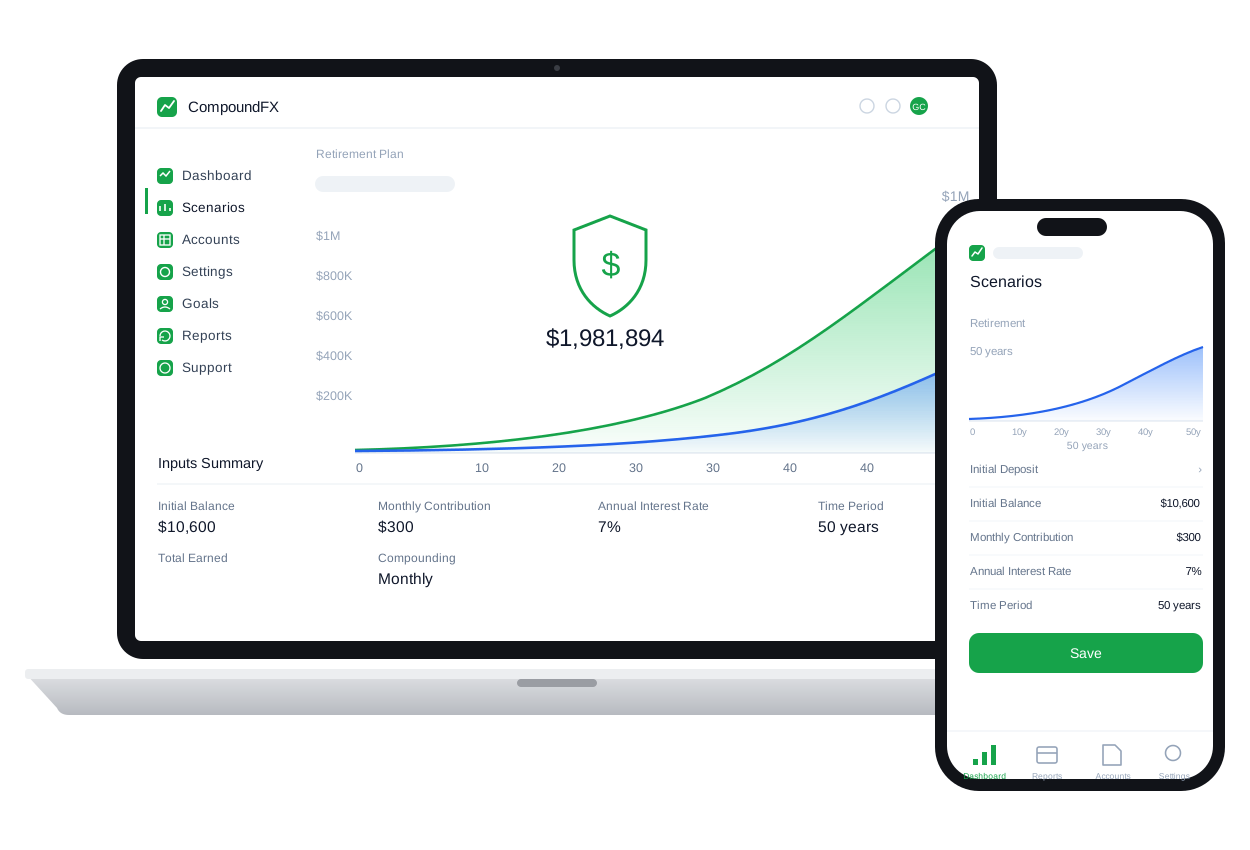
The difference between simple and compound interest is what the interest is calculated on: simple interest pays only on your original principal, while compound interest pays on the principal plus every dollar of interest already earned. Over one year the two are nearly identical; over thirty years, compound interest more than doubles the outcome of the same deposit at the same rate.
What is simple interest?
Simple interest is a fixed charge on the original amount only, so the same dollar amount is earned every period. Its formula is : a $10,000 deposit at 7% simple interest earns $700 every year, whether it’s year one or year thirty. After 30 years you’d have $31,000.00 — your principal plus $21,000 of perfectly linear interest.
Simple interest still exists in the real world: many auto loans, some personal loans and short-term notes, and bond coupons (when you don’t reinvest them) all pay or charge interest this way.
What is compound interest?
Compound interest recalculates on your full balance every period, so the interest itself earns interest. Its formula is — the same $10,000 at 7% compounded annually reaches $76,122.55 in 30 years. Nothing about the deposit or the rate changed; the only difference is that each year’s $700-and-growing interest stays in the account and starts working.
How much more does compound interest earn?
The gap starts small and widens relentlessly — after 30 years, compounding is ahead by $45,122.55 on a $10,000 deposit:
| Years | Simple Interest | Compound Interest | Compounding Advantage |
|---|---|---|---|
| 10 | $17,000.00 | $19,671.51 | +$2,671.51 |
| 20 | $24,000.00 | $38,696.84 | +$14,696.84 |
| 30 | $31,000.00 | $76,122.55 | +$45,122.55 |
Read the last column top to bottom: the compounding advantage roughly quadruples between year 10 and year 20, then more than doubles again by year 30. That’s the fundamental shape of the comparison — simple interest grows along a straight line, compound interest along an exponential curve, and the distance between a line and a curve grows faster than either one.
Why does the gap accelerate?
The gap accelerates because compound interest earns “interest on interest,” and that second layer grows every single year. In year one there is no past interest, so both methods pay identically. In year two, compounding pays 7% on $700 of year-one interest — a mere $49 head start. But every year adds another layer, and every layer compounds too. By year 30 the majority of the compound account’s growth is coming from money the original deposit generated, not from the deposit itself.
This is also why the comparison is so sensitive to time. If you only invest for a year or two, it genuinely doesn’t matter much which type of interest you earn. If you invest for decades, nothing matters more.
Which one applies to you?
For savings and investments you will almost always experience compound growth, while some loans charge simple interest — and that asymmetry can work in your favor. Savings accounts, CDs, and reinvested portfolios all compound. A simple-interest auto loan, by contrast, doesn’t snowball against you the way a compounding credit-card balance does. The dangerous quadrant is compound interest working against you: revolving credit-card debt compounds daily at rates far above what diversified investments typically return.
How can you tell which one you’re getting?
Read the account or loan terms for how interest is calculated, not just the headline rate. Three quick tells:
- Savings products quoting APY are compound by definition — APY exists precisely to express the effect of compounding. If you see APY, you’re compounding; the fine print will say how often.
- Loans described as “simple interest” (common for auto loans) calculate interest on the outstanding principal only. Paying early genuinely reduces total interest, because no unpaid interest ever joins the balance.
- Revolving credit that capitalizes interest — credit cards, deferred-interest promotions, some student loans — adds unpaid interest to what you owe, and from then on you pay interest on the interest. The phrase to hunt for is “interest is capitalized” or “added to principal.”
When the documents are ambiguous, assume investments compound and ask the lender directly about loans; the difference is worth an email.
The takeaway
When you compare financial products or project your own savings, always check whether — and how often — interest compounds. A “7% return” means very different things over 30 years depending on the answer: $31,000.00 without compounding versus $76,122.55 with it. The compounding frequency article covers the “how often” half of that question, and the calculator will happily show you both sides of the curve.
Put it into practice
See what these numbers look like with your own deposit, rate, and timeline.